
Modern applications generate and consume data in ways that traditional databases were never designed to handle. From social media feeds and e-commerce catalogs to real-time IoT streams and recommendation engines, the sheer volume, variety, and velocity of data today demands something far more flexible. That is precisely why NoSQL databases emerged — not to replace relational systems, but to fill the gaps they were never built for.
If you have heard the term NoSQL but are not quite sure what it means or when it makes sense, this guide breaks it down clearly. We cover how NoSQL differs from traditional databases, the four main NoSQL types, the key benefits, the most common real-world use cases, and the situations where NoSQL may not be the right fit.
What a NoSQL Database Actually Means
The term NoSQL stands for not only SQL — a clarification that this is not simply an anti-SQL movement, but a broader category of database systems that store and retrieve data in ways other than the rows-and-columns model of relational databases.
NoSQL databases are defined by several shared characteristics:
- Flexible or schema-less design — data structure can vary between records without breaking the system
- Horizontal scaling — adding more servers rather than upgrading one large machine
- Non-tabular data models — data is stored as documents, key-value pairs, wide columns, or graph nodes
- Optimized for specific workloads — each NoSQL type is tuned for particular query and access patterns
NoSQL databases gained mainstream adoption in the 2000s as companies like Google, Amazon, and Facebook faced data challenges that relational databases could not handle efficiently at web scale.
How NoSQL Differs From Relational Databases
Understanding the contrast between NoSQL and relational (SQL) databases is essential before choosing one. Here is a direct comparison across the dimensions that matter most:
Schema and Structure
Relational databases enforce a fixed schema — every row in a table must follow the same column structure. NoSQL databases are typically schema-flexible, meaning each record can carry different fields. This makes NoSQL far easier to work with when your data model is evolving or naturally inconsistent across records.
Scaling Approach
Relational databases scale vertically — you add more CPU, RAM, or storage to a single server. NoSQL databases are built for horizontal scaling — distributing data across many commodity servers. This makes NoSQL the natural choice for applications that need to grow rapidly without hitting single-machine hardware limits.
Joins and Relationships
SQL databases are engineered for complex joins between normalized tables. Most NoSQL databases avoid or minimize joins by encouraging you to store related data together in a single record. This trade-off accelerates read performance at the cost of some data modeling flexibility.
Consistency Model
Relational databases typically follow ACID properties — Atomicity, Consistency, Isolation, Durability — for strict transactional consistency. Many NoSQL databases follow the BASE model — Basically Available, Soft state, Eventually consistent — which prioritizes availability and performance over absolute consistency.
The Four Main Types of NoSQL Databases
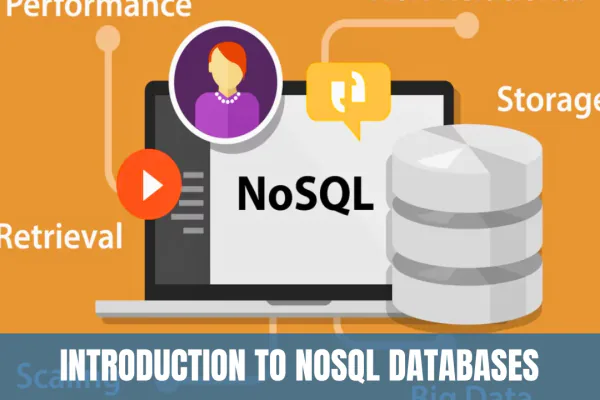
NoSQL is not a single product. It is a category that contains several distinct data models. Understanding each type makes it far easier to pick the right tool for a given problem.
1. Key-Value Stores
The simplest NoSQL model stores data as a collection of key-value pairs — essentially a dictionary or hash map at massive scale. Redis and Amazon DynamoDB are well-known examples. Key-value stores deliver extremely fast lookups and are most commonly used for session management, caching, and real-time leaderboards.
2. Document Databases
Data is stored as semi-structured documents, typically in JSON or BSON format, where each document can have its own unique structure. MongoDB and CouchDB are the leading examples. Document databases work especially well for product catalogs, content management systems, and user profiles that naturally vary in shape.
3. Wide-Column Stores
Data is organized in tables with rows and dynamic columns, where different rows can hold different columns. Apache Cassandra and Google Bigtable follow this model. Wide-column stores excel at ingesting and querying time-series data, IoT sensor streams, and analytics workloads at enormous scale.
4. Graph Databases
Data is represented as nodes and edges, making relationships between entities first-class citizens of the data model. Neo4j is the most widely used graph database. This model is purpose-built for social networks, fraud detection, recommendation engines, and any domain where the connections between data points matter as much as the data itself.
Key Benefits of Using NoSQL
NoSQL databases offer several real advantages for the workloads they are designed for:
- Flexible data modeling: No predefined schema means faster iteration during development and easier handling of changing data requirements.
- Horizontal scalability: Spreading data across commodity servers makes it cost-effective to scale read and write throughput independently.
- High write throughput: Many NoSQL systems are optimized for writing large volumes of data quickly — essential for logging pipelines, event tracking, and IoT data collection.
- Speed for predictable access patterns: When queries are simple and consistent — like fetching a user record by ID — NoSQL often responds faster than a multi-table SQL join.
- Built for distributed systems: NoSQL databases are designed from the ground up to run across multiple nodes, data centers, and cloud regions with built-in replication and fault tolerance.
- Natural fit for unstructured data: Storing nested JSON objects, variable-length records, or mixed-field documents is straightforward in NoSQL and awkward in rigid relational tables.
Common Use Cases for NoSQL Databases
The clearest way to understand NoSQL’s value is to look at where it is already being used successfully in production:
Session Storage and Caching
Applications need fast, temporary storage for user sessions, authentication tokens, and cached API responses. Key-value stores like Redis handle millions of these operations per second at sub-millisecond latency — a performance level that relational databases simply cannot match for this pattern.
E-Commerce Product Catalogs
Products have wildly different attributes. A laptop has CPU and RAM specs; a shirt has size and color. Document databases handle this naturally — each product is a self-contained document with only the fields that apply to it, without forcing empty columns for irrelevant attributes.
Real-Time Analytics and IoT Data
Wide-column stores like Cassandra are built to ingest high-velocity streams of time-stamped data — sensor readings, application logs, clickstream events — and query them efficiently by time range or device ID, even at billions of records.
Social Graphs and Recommendation Engines
Graph databases make it straightforward to answer questions like which products do people similar to this user also buy, or who are the mutual connections between two accounts — queries that would require deeply complex multi-join SQL statements.
Content Management Platforms
Blogs, media sites, and headless CMS platforms deal with documents of varying structure and nesting. MongoDB-style document storage maps closely to how content is created and consumed, simplifying both reads and writes for content-heavy applications.
When NoSQL May Not Be the Best Choice
NoSQL is a powerful tool, but it is not always the right one. Relational databases remain the better choice when:
- Your data model is highly relational: If your application depends on complex multi-table joins and strict referential integrity, a relational database remains cleaner and safer.
- You need full ACID transactions: Financial systems, billing platforms, and inventory management typically require guaranteed consistency across multiple operations — something most NoSQL systems only partially provide.
- Ad-hoc reporting is a core requirement: SQL’s expressive query language and mature BI tooling ecosystem are difficult to replicate across most NoSQL systems.
- Your team knows SQL well: Familiarity matters. A well-tuned PostgreSQL database in experienced hands often outperforms a poorly configured NoSQL cluster maintained by a team unfamiliar with the new model.
How to Choose the Right NoSQL Model
Once you have decided NoSQL is appropriate, use this practical framework to narrow down which type to use:
- What shape is your data? Nested JSON documents map to document stores. Flat key lookups map to key-value stores. Rows with variable columns map to wide-column stores. Entities with rich relationships map to graph databases.
- What are your primary query patterns? NoSQL databases are optimized for specific access patterns. Define how you will read and write data before choosing, not after.
- How fast do you expect to grow? If 10× traffic growth is realistic within a year, horizontal scaling support becomes a critical selection factor.
- How important is strict consistency? If every write must be immediately visible to every reader, evaluate each database’s consistency guarantees carefully before committing.
- What does your team already operate? Operational familiarity and strong community support reduce risk significantly, especially for teams adopting NoSQL for the first time.
Final Takeaways on NoSQL in Modern Software
NoSQL databases have become essential building blocks of modern software architecture — not because they are universally superior to relational systems, but because they are purpose-built for classes of problems that SQL databases were never designed to solve at scale. The core insight worth remembering is that NoSQL is a category of tools, not a single product, and each type within that category excels in a different context.
The most effective engineering teams do not choose between SQL and NoSQL as a philosophical stance. They match the database model to the workload. A well-chosen NoSQL database can simplify your architecture, cut infrastructure costs at scale, and accelerate development. A poorly chosen one adds operational complexity without meaningful benefit.
Understanding the four core NoSQL types — key-value, document, wide-column, and graph — and recognizing which real-world scenarios each fits best gives you a solid, practical foundation for making smarter database decisions as your applications grow and evolve.
