
When you start building an application or designing a data system, one of the earliest and most consequential decisions you face is choosing a database. At the center of that decision is a question that trips up even experienced developers: should you go with a SQL database or a NoSQL one? The names alone can feel like marketing labels, but they represent genuinely different philosophies about how data should be stored, queried, and scaled.
Neither SQL nor NoSQL is universally better. The right choice depends on your data structure, how your application is expected to grow, what kind of queries you need to run, and how much you can afford to trade consistency for speed. This article walks through the real differences and gives you a clear framework for making the call that fits your project.
What SQL and NoSQL Mean
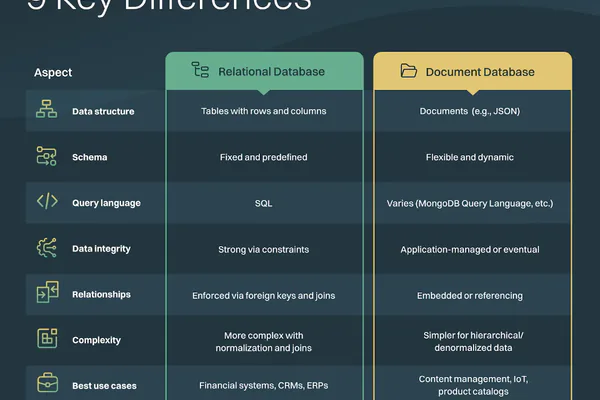
SQL stands for Structured Query Language, and SQL databases are more formally called relational databases. They organize data into tables made up of rows and columns, and they use SQL as a standardized language for creating, reading, updating, and deleting records. Popular SQL databases include MySQL, PostgreSQL, Microsoft SQL Server, and SQLite.
NoSQL is a broad term covering any database that does not follow the traditional relational model. The name is sometimes interpreted as “Not Only SQL” to acknowledge that certain NoSQL systems support SQL-like syntax. NoSQL databases include document stores like MongoDB, key-value stores like Redis, wide-column databases like Cassandra, and graph databases like Neo4j. Each model is optimized for a different category of problem.
How Their Data Models Differ
The Relational Model
SQL databases store data in tables. Each table has a predefined schema specifying column names and data types. Rows represent individual records. Relationships between tables are enforced through foreign keys, and data from multiple tables can be retrieved together using JOIN operations. This model works cleanly when data has consistent structure and clear, stable relationships.
NoSQL Data Models
NoSQL databases come in several flavors, each suited to different access patterns:
- Document stores save records as JSON-like documents. Each document can carry a different structure, making them well suited to varied or frequently changing data.
- Key-value stores pair a unique key with a value, enabling extremely fast lookups. Ideal for caching, session storage, and real-time counters.
- Wide-column stores organize data by column families rather than rows, optimized for queries over massive datasets with sparse attributes.
- Graph databases represent data as nodes and edges, making them powerful for relationship-heavy problems like social networks, recommendation engines, and fraud detection.
Schema, Queries, and Flexibility
SQL: Rigid but Predictable
SQL databases require a defined schema before you insert data. You declare tables, column names, and data types upfront. This strictness is a feature, not a limitation: it enforces data consistency and keeps the database self-documenting. Schema changes, such as adding a column, require a migration that alters the table structure in a controlled way.
SQL queries are expressive and standardized. JOINs combine data from multiple tables, aggregate functions summarize large datasets, and subqueries enable nested logic. If your application needs to ask complex relational questions, SQL makes answering them both efficient and readable.
NoSQL: Flexible but Requires Discipline
Most NoSQL databases are schema-less or schema-optional. You can insert a document of any shape without declaring a structure first. This accelerates early development and accommodates rapidly changing requirements. The tradeoff is that application-level validation becomes your responsibility. Without schema enforcement at the database layer, data inconsistencies can accumulate if the development team is not deliberate about structure.
Scaling and Performance Tradeoffs
Vertical vs Horizontal Scaling
SQL databases traditionally scale vertically: you give the server more CPU, RAM, and storage as load increases. This works well up to a point, but hardware has limits and costs grow steeply. Horizontal scaling across multiple nodes is possible with SQL but requires careful planning, especially for write-heavy workloads.
Most NoSQL databases are designed from the ground up for horizontal scaling. They distribute data across a cluster of commodity servers, and adding nodes increases capacity linearly. This makes them well suited to applications expecting massive growth or unpredictable traffic surges.
Performance Is Workload-Dependent
A well-indexed SQL database will outperform a NoSQL store for complex relational queries. Conversely, a key-value store like Redis returns a cached value in microseconds, far faster than any relational query. Meaningful performance comparisons between SQL and NoSQL always depend on the specific query pattern and data volume in question, not on the database category alone.
Consistency, Transactions, and Reliability
ACID in SQL Databases
SQL databases are built around ACID properties: Atomicity, Consistency, Isolation, and Durability. In practice this means a transaction either fully completes or fully rolls back, no partial writes slip through, and once data is committed it remains durable even through a crash. This level of reliability is non-negotiable for financial transactions, inventory systems, and any domain where data integrity is critical.
The CAP Theorem and NoSQL Tradeoffs
NoSQL systems often make different tradeoffs based on the CAP theorem, which states that a distributed system can guarantee at most two of three properties: Consistency, Availability, and Partition tolerance. Many NoSQL databases prioritize availability and partition tolerance, accepting eventual consistency. Reads may return slightly stale data, but the system stays responsive during network partitions. This is acceptable for social feeds, analytics dashboards, or product catalogs. It is not acceptable for banking ledgers or medical records.
When SQL Is the Better Choice
SQL databases excel in scenarios where structure, relationships, and integrity matter most:
- Financial applications requiring atomic, multi-table transactions
- ERP and CRM systems with structured, tightly interrelated data models
- Reporting and business intelligence platforms relying on complex aggregations and JOINs
- Applications with well-defined schemas that are unlikely to change frequently
- Projects where the team has strong SQL expertise and long-term maintainability is a priority
When NoSQL Makes More Sense
NoSQL databases are a natural fit when flexibility, speed, or massive scale override the need for strict relational integrity:
- Real-time applications like chat systems, gaming leaderboards, or live activity feeds that require millisecond response times
- Content platforms where posts, comments, and metadata vary in structure across users
- Large-scale user-generated data with billions of records that would be costly to shard across SQL nodes
- Caching layers where key-value lookups replace repeated, expensive database reads
- IoT data pipelines ingesting high-velocity sensor readings in diverse and unpredictable formats
- Rapid prototyping environments where data models evolve multiple times per development sprint
SQL vs NoSQL at a Glance
| Factor | SQL | NoSQL |
|---|---|---|
| Data structure | Tables, rows, columns | Documents, key-value, graph, wide-column |
| Schema | Fixed, predefined | Flexible or schema-less |
| Scaling model | Primarily vertical | Designed for horizontal |
| Transactions | Full ACID support | Varies; often eventual consistency |
| Query language | Standardized SQL with JOINs | Model-specific APIs or query syntax |
| Best fit | Structured, relational data with strict integrity | Flexible, high-volume, or rapidly changing data |
How to Choose for Your Project
Rather than defaulting to one side based on current trends, work through these decision points systematically:
- How structured is your data? If every record shares the same fields and relationships between records matter, SQL is the cleaner fit. If records vary widely in shape, NoSQL document models are more natural.
- What scale are you targeting? Millions of records in a well-indexed relational database is not a challenge. Billions of records distributed across global infrastructure leans toward NoSQL.
- How strict is your integrity requirement? Finance, healthcare, and legal systems generally demand ACID transactions. Analytics and content platforms can usually tolerate eventual consistency.
- What query patterns will dominate? Complex multi-table JOINs favor SQL. Simple lookups by ID, range scans, or graph traversals favor specialized NoSQL models.
- What is your team’s experience? A team with deep SQL expertise can often outperform a team learning a new NoSQL model, even on workloads that theoretically favor NoSQL on paper.
Common Misconceptions to Avoid
Several beliefs about SQL vs NoSQL are widespread but misleading:
- “NoSQL is always faster.” Speed depends entirely on the access pattern. Key-value lookups in Redis are faster than any SQL query, but complex aggregations over a large NoSQL document collection can be slower than the equivalent SQL query with proper indexing.
- “SQL cannot scale.” Modern relational databases like PostgreSQL and MySQL handle enormous workloads through read replicas, table partitioning, and connection pooling. Many high-traffic companies run SQL at massive scale without issue.
- “You must pick one.” Polyglot persistence is common and often the smartest approach. A single application might use PostgreSQL for transactional data, Redis for caching, and Elasticsearch for full-text search simultaneously.
- “NoSQL is simpler.” NoSQL shifts complexity from the database layer to the application layer. Managing consistency, handling schema evolution in code, and building relational logic manually is often harder than writing well-structured SQL.
Choosing between SQL and NoSQL is ultimately about matching the database model to the problem at hand. SQL databases deliver structure, relational integrity, and powerful query capabilities that are difficult to replicate elsewhere. NoSQL databases offer flexibility, horizontal scalability, and specialized performance characteristics suited to high-demand, varied workloads. The best approach is to treat this as a technical decision driven by your actual requirements — not a preference shaped by trend — and let your data structure, consistency needs, expected growth, and team strengths guide you to the right answer.
