

Software development has long been the domain of trained engineers writing thousands of lines of code. But that picture is shifting. Low-code development platforms are changing how organizations build software by letting teams assemble applications through visual interfaces, reusable components, and minimal manual coding. The result is faster delivery, broader participation, and — when used well — real cost savings.
The appeal is obvious: fewer bottlenecks, shorter timelines, and the ability to involve non-engineers in the building process. Yet low-code is not a silver bullet. It comes with real constraints around customization, security, and long-term ownership that teams often discover too late. This guide explains what low-code development actually is, where it works, and where it runs into trouble — so you can make an informed decision before committing to a platform.
What Low-Code Development Actually Means
The Core Concept
Low-code development is an approach to building software applications that reduces the need to write code manually. Instead of constructing every feature from scratch, developers and non-developers alike use visual drag-and-drop builders, prebuilt components, workflow automations, and configuration panels to assemble working applications quickly.
The low in low-code is important: unlike fully no-code tools that eliminate coding entirely, low-code platforms still allow — and sometimes require — developers to write custom code for advanced logic, integrations, or edge cases. This keeps low-code flexible enough for moderately complex projects while staying far faster than traditional development.
Low-Code vs. No-Code vs. Traditional Development
- Traditional development: Engineers write all code by hand. Maximum control, maximum flexibility, longest timelines.
- Low-code: Visual tools handle most of the heavy lifting; developers still write code when needed. Balances speed with flexibility.
- No-code: Anyone can build apps without writing any code. Fast for simple tools, but limited for complex or custom requirements.
Popular low-code platforms include Microsoft Power Apps, OutSystems, Mendix, Appian, and Salesforce Lightning. Each targets different use cases, from enterprise automation to simple internal dashboards.
How Low-Code Platforms Work in Practice
Most low-code platforms share a common set of building blocks that speed up the development process significantly. Understanding these components helps teams evaluate platforms with realistic expectations.
Visual Builders and Drag-and-Drop Interfaces
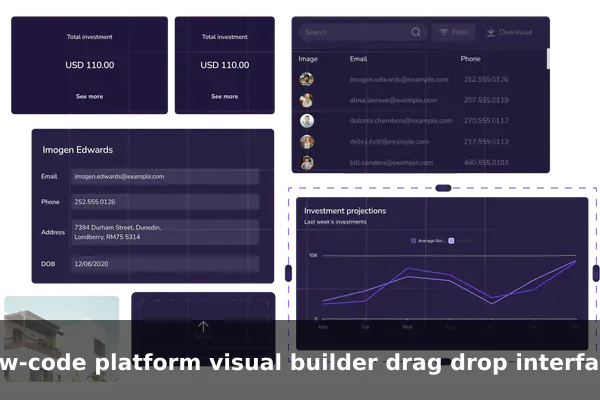
The centerpiece of any low-code platform is a visual interface where users place and configure UI components — buttons, forms, tables, charts — without writing HTML or CSS. Changes appear in real time, making it easier to prototype and iterate quickly.
Prebuilt Workflows and Automation
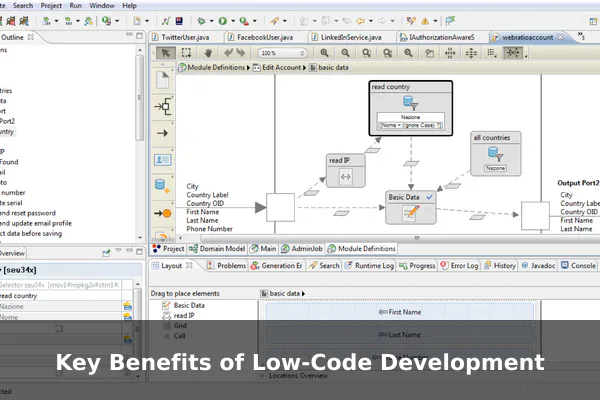
Low-code platforms come with workflow engines that let users define business logic through flowcharts or rule-based editors. Approval flows, notifications, conditional branching, and scheduled tasks can all be configured visually rather than coded from scratch.
Connectors and Integrations
Most platforms offer a library of prebuilt connectors to popular services — databases, email providers, CRMs, payment processors, and APIs. This means teams can link their application to existing systems in hours rather than days.
Optional Custom Code
When prebuilt components are not enough, low-code platforms typically allow developers to inject custom code — JavaScript, Python, or SQL — at specific points. This escape hatch is what separates low-code from no-code and makes it usable for more demanding projects.
Key Benefits of Low-Code Development
The growing popularity of low-code platforms is not accidental. They offer concrete advantages for many organizations, especially those dealing with engineering backlogs, resource constraints, or frequent process changes.
Faster Prototyping and Delivery
Low-code significantly compresses development timelines. A working prototype that might take weeks with traditional code can often be assembled in days. This speed matters enormously for testing ideas, responding to changing business needs, or delivering internal tools quickly.
Reduced Dependence on Engineering Bottlenecks
In many organizations, development teams are overloaded with requests. Low-code platforms allow business analysts, operations staff, and domain experts to build and maintain applications without relying entirely on engineering. This is sometimes called citizen development.
Lower Cost for Standard Use Cases
For well-defined, repeatable use cases — forms, dashboards, approval workflows — low-code can dramatically reduce development and maintenance costs compared to building custom software from scratch.
Shorter Release Cycles and Better Collaboration
Because low-code tools make application logic visible and configurable, business stakeholders can participate more directly in development. This reduces miscommunication, speeds up feedback loops, and enables teams to ship updates faster without long engineering cycles.
Where Low-Code Fits Best
Low-code delivers the most value in specific types of projects. Knowing where it excels helps teams decide whether it is the right tool before they start building.
- Internal tools: Employee portals, HR forms, IT request systems, and admin dashboards are ideal for low-code because they have predictable requirements and modest traffic.
- Process automation: Approval workflows, document routing, notifications, and multi-step business processes map well onto low-code workflow engines.
- CRM extensions and sales tools: Adding custom modules to existing platforms like Salesforce is often faster with low-code than with traditional development.
- Line-of-business applications: Department-specific tools — inventory trackers, project status boards, reporting dashboards — benefit from the speed of low-code delivery.
- MVPs and prototypes: When testing a new idea quickly matters more than perfect architecture, low-code can validate a concept before committing to full development.
The Main Limits Teams Should Understand
Low-code is not suited for every project. Teams that ignore these constraints often find themselves either rebuilding in traditional code or stretching a platform far beyond what it was designed for.
Limited Customization
Prebuilt components are convenient, but they have boundaries. Highly specific UI requirements, unusual business logic, or niche integrations can be difficult or impossible to implement inside a low-code platform’s constraints. The further a project departs from standard patterns, the more friction developers encounter.
Performance Ceilings
Low-code applications often introduce overhead through abstraction layers and generalized rendering engines. For applications that require high-throughput processing, real-time data handling, or low-latency responses, platform-generated code may underperform compared to hand-tuned solutions.
Portability and Scaling Problems
Applications built on low-code platforms are typically tied to that platform’s data model, runtime, and deployment environment. Moving to a different system — or switching vendors — can mean rebuilding significant portions of the application from scratch. Similarly, products with deep technical requirements such as complex distributed systems or advanced data pipelines are generally better served by traditional development where engineers have full architectural control.
Security, Compliance, and Vendor Risks
Beyond technical constraints, low-code adoption introduces governance and risk considerations that teams often underestimate at the start.
Access Control and Shadow IT
Citizen development can lead to sensitive data being handled in applications built by non-security-trained staff. Without proper governance policies, employees may create apps that expose confidential data, misconfigure permissions, or bypass existing data access controls — a pattern commonly called shadow IT.
Vendor Lock-In
Low-code platforms are proprietary by nature. Business logic, data models, and workflows built inside a platform are often non-transferable. If the vendor changes pricing, discontinues features, or exits the market, organizations may be left with few options besides a costly migration.
Compliance Exposure
For organizations operating under GDPR, HIPAA, SOC 2, or other compliance frameworks, the question of where data lives and how it is processed inside a third-party low-code platform is critical. Not all platforms provide the audit trails, data residency controls, or access logs that compliance teams require.
How to Decide Whether Low-Code Is the Right Choice
The decision to use low-code should be based on honest assessment of the project’s requirements. Consider these factors before committing to a platform:
- Project complexity: If the project fits standard patterns — forms, workflows, dashboards — low-code is a strong candidate. If it requires deep customization or unusual architecture, traditional development may be more efficient in the long run.
- Compliance requirements: Verify that your chosen platform can meet audit, residency, and access control requirements before committing.
- Expected growth and scale: Applications expected to grow into high-traffic, data-intensive systems may hit platform limits sooner than expected.
- Total cost over time: Factor in subscription fees, per-user licensing, upgrade costs, and eventual migration costs when comparing low-code to custom development. Low-code can be cheaper short-term but more expensive long-term for large-scale applications.
- Integration demands: Audit whether the platform’s connector library actually covers your existing stack before starting.
Low-Code Development at a Glance
Low-code development occupies a practical middle ground in modern software delivery. It is faster than traditional coding, more flexible than no-code tools, and genuinely useful for a wide range of business applications — especially when teams need to move quickly on internal tools, process automation, or iterative product work.
But it is not a universal answer. Customization limits, performance ceilings, vendor lock-in, and governance risks are real. The strongest uses of low-code are deliberate ones: teams that choose it for the right type of project, maintain proper oversight, and plan for the day they might need to move beyond it.
Quick Comparison: Benefits, Limits, and Risks
- Benefits: Faster delivery, lower engineering burden, better business-developer collaboration, cost savings on standard use cases, shorter feedback loops.
- Limits: Constrained customization, performance overhead, portability issues, difficulty scaling complex systems, shallow integration depth for unusual stacks.
- Risks: Vendor lock-in, shadow IT proliferation, compliance exposure, access control gaps, long-term maintainability challenges.
Used with clear eyes and a realistic scope, low-code development is a genuinely powerful tool. The teams that benefit most are the ones who understand both its advantages and its edges — and plan accordingly from day one.
