
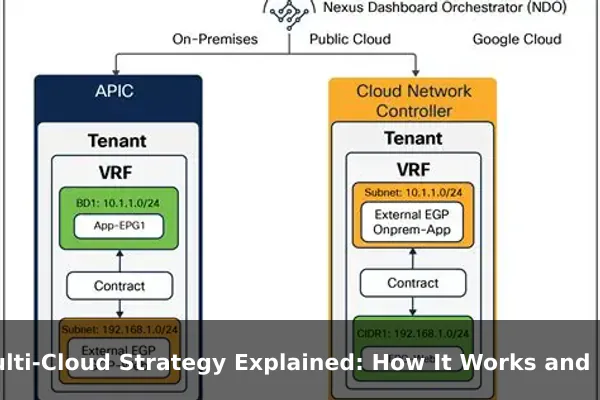
A multi-cloud strategy is one of the most important ideas in modern IT planning, yet it is often misunderstood. Some people assume it simply means using more than one cloud account. Others think it is the same as hybrid cloud. In practice, multi-cloud is a deliberate way to design, place, and manage workloads across two or more cloud providers so a business can gain more flexibility, resilience, and control.
This matters because companies no longer buy technology in one big block. They run websites, data platforms, collaboration tools, analytics pipelines, customer apps, backup systems, and AI services at the same time, and those workloads rarely have identical needs. One cloud provider may be stronger for machine learning, another for enterprise integrations, and another for regional availability or pricing. A smart multi-cloud strategy lets an organization match the right workload to the right environment instead of forcing everything into a single platform.
At the same time, multi-cloud is not automatically better. It can reduce dependency on one vendor and improve business continuity, but it can also create more operational complexity. The most useful way to understand it is to look at how it works in real environments, why businesses choose it, what benefits it can unlock, and when the added complexity is actually worth it.
What a Multi-Cloud Strategy Means
At its core, a multi-cloud strategy means an organization uses multiple public cloud providers as part of one overall operating model. Those providers might include Amazon Web Services, Microsoft Azure, Google Cloud, or other specialized platforms. The important point is that the business is not using multiple clouds by accident. It is making a conscious architectural decision about where workloads should run and why.
That distinction matters. Many companies already have accounts with more than one provider because teams signed up separately over time. That situation is often just cloud sprawl. A real multi-cloud strategy adds governance, standards, and business logic. It answers questions such as:
- Which workloads belong on which cloud?
- How will identity, security, and access rules stay consistent?
- How will data move between platforms?
- What tools will monitor cost, performance, and reliability across all providers?
- What happens if one provider has an outage or a service change?
A useful plain-English definition is this: multi-cloud is the practice of running different business applications or services across different cloud providers on purpose, based on technical and business needs.
It Is a Strategy, Not Just a Technology Choice
The word strategy is important. Multi-cloud is not only about servers, storage, or containers. It also involves procurement, compliance, resilience planning, team skills, cost management, and vendor relationships. For example, a business may keep customer-facing apps on one provider, analytics on another, and backup or disaster recovery on a third because that arrangement supports better risk management and performance.
Not Every Application Must Run Everywhere
One common misconception is that a multi-cloud setup means every application is duplicated across every provider. That is rarely the case. In most real-world designs, different workloads are distributed based on need. Some critical services may be portable across clouds, while others stay deeply integrated with a single provider because the benefits of moving them do not justify the cost or effort.
Multi-Cloud vs. Hybrid Cloud
People often confuse multi-cloud with hybrid cloud, but they are not the same model. A multi-cloud approach usually refers to using more than one public cloud provider. A hybrid cloud approach refers to combining public cloud resources with private infrastructure, such as on-premises data centers or private clouds.
In other words, the difference is about what is being combined:
- Multi-cloud: multiple public cloud providers
- Hybrid cloud: public cloud plus private or on-premises infrastructure
A company can also do both at once. For example, it might keep sensitive manufacturing systems in a private data center, use Azure for identity and business software, and use Google Cloud for analytics. That environment is both hybrid and multi-cloud.
Why the Difference Matters
The distinction matters because the design challenges are different. In a hybrid cloud model, the big concern is often how to connect older internal systems with cloud services securely and efficiently. In a multi-cloud model, the challenge is more about coordinating multiple vendors, multiple control planes, and multiple service ecosystems.
That means the tools, skills, and governance models are not identical. Hybrid cloud discussions often focus on networking back to on-premises systems, data residency inside corporate facilities, and migration from legacy infrastructure. Multi-cloud discussions focus more on workload placement, interoperability, vendor diversification, and cross-platform management.
A Quick Comparison
- Main purpose: Hybrid cloud extends private systems into the cloud, while multi-cloud spreads services across multiple public providers.
- Main design problem: Hybrid cloud deals with integration between internal and external environments, while multi-cloud deals with consistency across external platforms.
- Typical driver: Hybrid cloud is often driven by legacy systems or data control, while multi-cloud is often driven by resilience, flexibility, or best-of-breed service selection.
Understanding this difference helps readers evaluate the right architecture instead of treating every cloud model as interchangeable.
How Multi-Cloud Works in Real Environments
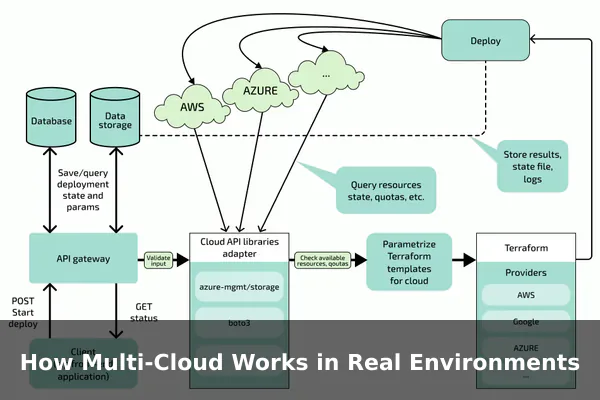
A multi-cloud environment works by distributing workloads across providers according to specific goals. Those goals can include cost, geographic reach, availability, compliance, or access to specialized services. In practice, this means a company creates a design standard for networking, identity, deployment, monitoring, and data handling, then maps each workload to the provider that fits best.
Workloads Are Placed by Strength, Not by Habit
Imagine an online retail company. It might use one provider for its storefront because that platform offers mature scaling and global content delivery. It might use another for analytics because its data warehouse and machine learning tools are stronger there. It might use a third for backup, archiving, or regional disaster recovery. The business is not splitting systems randomly. It is assigning each part of the stack to the environment that serves it best.
Common multi-cloud workload patterns include:
- Running production applications on one cloud and disaster recovery on another
- Using one provider for general infrastructure and another for advanced analytics or AI
- Keeping separate regional workloads on providers with stronger local presence
- Supporting mergers or acquisitions where different business units already rely on different clouds
- Meeting industry rules by placing regulated data in a specific provider or region
The Shared Layers That Make It Possible
For multi-cloud to work well, organizations usually standardize several shared layers:
- Identity and access management: Users, admins, and services need controlled access across providers without inconsistent permissions.
- Networking: Systems must communicate securely across clouds through private links, VPNs, routing policies, and segmentation rules.
- Security policy: Encryption, logging, vulnerability management, and incident response need consistent rules.
- Observability: Teams need centralized visibility into performance, errors, uptime, and alerts.
- Automation: Infrastructure is often deployed using code so teams can reproduce environments with fewer manual errors.
- Data management: Businesses need clear rules for where data lives, how it is replicated, how it is synchronized, and who can move it.
What Happens When a User Request Flows Through Multi-Cloud
A simple request can involve several platforms at once. For example:
- A user opens a mobile or web app hosted on one cloud provider.
- The app authenticates the user through a centralized identity service.
- Application logic calls an API running in the same provider for low latency.
- Usage events are streamed to a second provider for analytics processing.
- Backups or replicated snapshots are copied to a third environment for recovery planning.
- Monitoring tools aggregate logs and metrics from all of them into one dashboard.
From the user’s point of view, it still feels like one application. Behind the scenes, the business is coordinating multiple platforms with shared policies and automation.
This is why multi-cloud is less about buying more cloud accounts and more about building an operating model. The architecture only works if the organization can manage the connections between clouds as carefully as the services inside them.
Why Companies Choose Multi-Cloud
Companies adopt a multi-cloud strategy for practical reasons, not because it sounds modern. In most cases, the decision comes from a mix of risk management, performance needs, and business flexibility.
Avoiding Vendor Lock-In
One of the biggest reasons is reducing dependence on a single provider. If every application, workflow, and data pipeline becomes tightly tied to one cloud vendor’s tools, it can become difficult and expensive to change direction later. A multi-cloud strategy gives businesses more room to negotiate contracts, switch priorities, or adopt new services without rebuilding everything around one ecosystem.
Improving Resilience and Business Continuity
No cloud platform is immune to outages, regional failures, or service disruptions. Spreading critical capabilities across more than one provider can improve resilience, especially for organizations where downtime has direct financial or operational impact. Even when full cross-cloud failover is not practical, having separate recovery options can reduce business risk.
Matching Workloads to the Best Service
Cloud providers do not all excel in the same areas. One may offer stronger enterprise productivity integration, another may provide better data analytics tooling, and another may have attractive pricing for specific compute patterns. A multi-cloud strategy allows teams to use best-fit services instead of accepting one-size-fits-all compromises.
Meeting Compliance, Data, or Geographic Needs
Some industries must keep data in certain locations or follow strict controls around how systems are managed. Multi-cloud can help when one provider has better coverage in a region, better certifications for an industry, or services that align more closely with a company’s regulatory obligations.
Supporting Organizational Reality
Sometimes the driver is simple: the company is already operating that way. Large enterprises often inherit multiple cloud environments through acquisitions, global expansion, or separate engineering teams. In that case, the question is no longer whether multi-cloud exists. The question becomes whether the organization will manage it strategically or leave it fragmented and inefficient.
Key Benefits of a Multi-Cloud Strategy
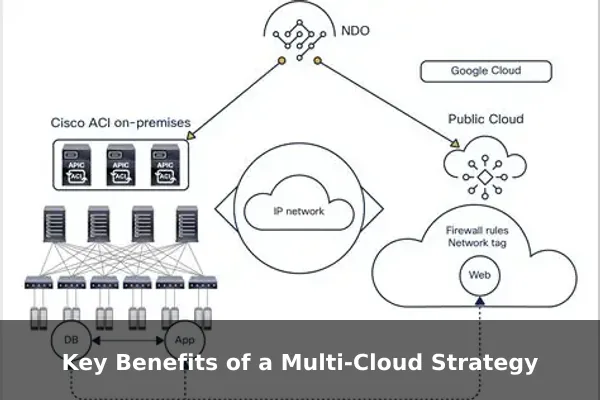
When a multi-cloud strategy is planned well, it can create both business and technical advantages. The value comes from deliberate placement and governance, not from adding clouds for their own sake.
Flexibility Without a Single-Provider Constraint
The most obvious benefit is flexibility. Teams can choose services that align with workload needs instead of forcing every application into one provider’s catalog. That flexibility can support faster innovation, especially when a business wants to test new capabilities such as data platforms, AI services, or regional deployment models.
Stronger Resilience Options
Using more than one provider can improve redundancy. If one vendor experiences a large disruption, another environment may support backup operations, recovery, or alternate service delivery. This does not happen automatically, but a well-designed multi-cloud architecture can give organizations more options than a single-cloud design.
Better Performance for Different Workloads
Performance is not only about raw speed. It also includes latency, user proximity, service quality, and the suitability of the platform for a task. A company serving users in different regions may choose providers with stronger local infrastructure. Another may place compute-intensive jobs on the platform with the best tools for scaling that workload efficiently.
Compliance and Regional Coverage
Multi-cloud can help businesses meet legal and operational requirements more precisely. If one provider has stronger presence or certifications in a specific geography, that can shape workload placement. This is especially useful for global organizations that must support different countries, business units, or data policies at the same time.
Negotiation Leverage and Commercial Control
Relying on one vendor can weaken a company’s negotiating position over time. A multi-cloud strategy can improve leverage because the business has credible alternatives. That does not always mean lower costs across the board, but it can create better commercial flexibility around contracts, service adoption, and long-term planning.
Service Specialization
Different providers have different strengths. Multi-cloud makes it possible to use those strengths intentionally. For example, a company may prefer one provider for identity and enterprise application integration, another for real-time data analytics, and another for low-cost archival storage. That specialization can produce better outcomes than treating all providers as interchangeable.
A Clearer Risk Distribution Model
From a strategy perspective, multi-cloud helps distribute risk across infrastructure, vendor roadmaps, regional service limits, and platform changes. This can be valuable for businesses with strict uptime expectations, customer commitments, or operational dependencies that are too important to place under one umbrella.
The Main Challenges to Plan For
Multi-cloud can be powerful, but it is not simple. Many organizations discover that the biggest challenge is not getting onto multiple cloud providers. It is operating them consistently over time.
Operational Complexity Increases Fast
Each cloud platform has its own services, terminology, permissions model, billing format, and management tools. When teams use several providers at once, day-to-day operations become harder unless standards are in place. Routine tasks such as access reviews, patching, networking, logging, and incident response can become fragmented.
Security Can Become Inconsistent
Security is one of the biggest risks in a poorly managed multi-cloud environment. If each team configures identity, encryption, secrets, and monitoring differently, gaps appear quickly. The problem is not that multi-cloud is insecure by nature. The problem is that inconsistency multiplies the chance of mistakes.
Cost Visibility Gets Harder
Cloud costs are already difficult to track in one environment. With several providers, businesses often struggle to see total spending, compare resource use fairly, or spot waste across teams. Pricing structures differ, discounts differ, and data transfer charges can become surprisingly expensive when workloads communicate across clouds.
Data Portability Is More Difficult Than It Sounds
Many executives like the idea of moving workloads easily between clouds, but real portability can be limited. Applications often become dependent on managed databases, storage services, event systems, or security tools that are specific to one provider. Moving data between clouds may also introduce latency, complexity, and extra cost.
Skills Gaps Slow Execution
A strong multi-cloud approach requires people who understand architecture, automation, security, and operations across more than one platform. That talent is harder to build and more expensive to maintain than a single-cloud skill base. Without clear ownership and training, teams can create weak points simply because they are stretching beyond their depth.
Governance Must Be Stronger, Not Looser
Some organizations move to multi-cloud in the name of flexibility, then accidentally make governance weaker. In reality, the opposite is needed. More providers mean more policies to enforce, more change to monitor, and more architectural decisions to review. Without disciplined governance, multi-cloud can turn into scattered tooling and rising risk.
Best Practices for Building a Strong Multi-Cloud Approach
The best multi-cloud strategies are usually selective, standardized, and business-led. They do not try to make every workload portable at any cost. Instead, they create a repeatable decision process for where workloads should live and how they should be operated.
Start With Business Outcomes
Before choosing platforms, define the goal. Is the business trying to reduce vendor concentration risk, improve global performance, meet compliance requirements, or adopt specialized services? A multi-cloud strategy should begin with those outcomes. Otherwise, the environment becomes more complicated without creating clear value.
Standardize the Control Layer
Even when workloads run on different providers, the management approach should feel consistent. That usually means standardizing:
- Identity and role design
- Security baselines
- Infrastructure-as-code methods
- Logging and monitoring practices
- Tagging and cost-allocation rules
- Backup and recovery expectations
These shared standards reduce friction and make operations more predictable.
Use Automation Wherever Possible
Manual setup does not scale well in multi-cloud. Automation helps teams build the same controls repeatedly, detect drift, and reduce configuration mistakes. Infrastructure as code, policy automation, and deployment pipelines are especially important because they turn cloud design into something testable and repeatable.
Apply Security Policies Centrally
A mature multi-cloud model treats security as a cross-platform discipline. Access controls, encryption requirements, secret handling, logging rules, and compliance checks should be defined centrally even if enforcement happens through provider-specific tools. The goal is not identical tooling everywhere. The goal is consistent security outcomes.
Invest in FinOps and Cost Discipline
Because multi-cloud can create hidden spending, financial governance matters from the start. Teams should track resource ownership, set budgets, review network transfer costs, and monitor underused services. Cost optimization in multi-cloud is not just about cheaper compute. It is about understanding the full economic effect of the architecture.
Decide Workload by Workload
Not every system needs the same treatment. A practical multi-cloud strategy evaluates each workload based on factors such as:
- Business criticality
- Compliance requirements
- Performance and latency needs
- Recovery objectives
- Integration dependencies
- Portability expectations
- Total cost of ownership
This workload-by-workload approach prevents overengineering. It also helps teams avoid the expensive mistake of trying to make everything equally portable.
Create an Operating Model, Not Just an Architecture Diagram
Many cloud strategies look impressive on slides but fail in operations. A good multi-cloud program defines who owns standards, who approves exceptions, how incidents are handled, how providers are evaluated, and how platform decisions are reviewed over time. That operational discipline is what separates a stable strategy from a collection of disconnected cloud choices.
When Multi-Cloud Makes Sense and When It Does Not
Multi-cloud is not the right answer for every organization. It makes sense when the expected business value is greater than the added complexity.
When It Makes Sense
A multi-cloud strategy is often a strong fit when:
- The business has strict uptime or continuity requirements and wants diversified recovery options.
- Different workloads clearly benefit from different provider strengths.
- Compliance, regional, or customer requirements vary across countries or business units.
- The company already operates multiple clouds and needs a unified management model.
- Vendor concentration risk is a serious board-level or operational concern.
When It May Not Make Sense
A single-cloud strategy may be better when:
- The organization is still early in its cloud journey and lacks platform maturity.
- The team is small and cannot support multiple provider skill sets responsibly.
- The workloads do not have distinct needs that justify spreading them out.
- The business values simplicity, speed, and lower operational overhead more than vendor diversification.
- Cross-cloud data movement or duplication would make the architecture unnecessarily expensive.
Questions to Ask Before Choosing Multi-Cloud
- What exact business problem does multi-cloud solve for us?
- Which workloads truly need to be diversified, and which do not?
- Do we have the skills and governance to operate multiple providers safely?
- Can we measure the cost of added complexity against the expected benefit?
- Are we pursuing resilience, portability, specialization, or simply reacting to organizational sprawl?
These questions help keep the decision grounded. In many cases, the best answer is not “all-in multi-cloud” or “single cloud only,” but a selective strategy where only certain workloads are intentionally distributed.
Conclusion
A multi-cloud strategy is best understood as a business and operating decision, not just a technical trend. It works by placing workloads across multiple cloud providers according to clear goals such as resilience, flexibility, compliance, performance, and service specialization. When executed well, it can reduce vendor dependence, improve risk distribution, and give organizations more architectural freedom.
However, the benefits only appear when the environment is managed with discipline. Multi-cloud adds complexity in security, cost control, governance, and skills, so it should be adopted for specific reasons rather than as a default assumption. The strongest approach is usually selective: use multiple clouds where they create clear value, standardize how they are managed, and keep the strategy tied to real business outcomes instead of cloud fashion.
